


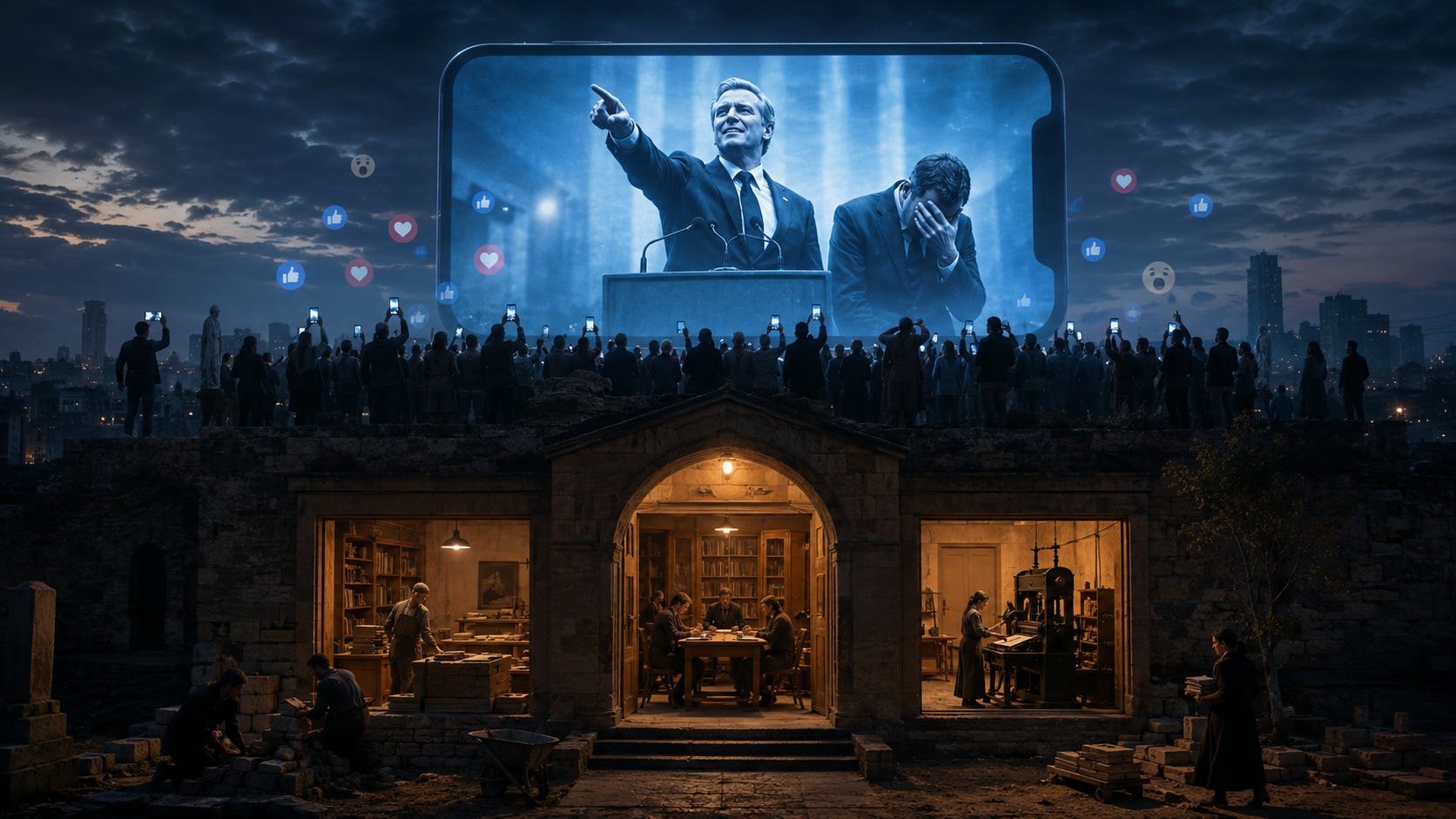
The modern Right has become very good at winning moments. A clip goes viral. A politician is humiliated in a debate. A journalist is exposed as dishonest. For a few hours, the dissident Right feels the tide turning.
Then nothing changes. The schools teach the same moral universe. The media class recovers by Tuesday. The corporations adjust their language, wait out the storm, and keep funding the same machinery. The people who laughed at the clip return to their mortgages and their streaming subscriptions.
Why does so much apparent victory produce so little durable power? Because much of the Right has mistaken attention for power. It has confused being seen with being obeyed, being shared with being trusted, being agreed with for five minutes with being able to shape how people live.
The false victory of being seen
Attention feels like power because it produces immediate feedback. Views, likes, reposts, followers. The numbers arrive quickly and give the mind something to hold.
Real power rarely gives such clean signals. A school formed around your ideas may take ten years to show results. A serious association may begin with twelve people in a room. A publishing project may lose money for years before it shapes the vocabulary of a generation. These things rarely trend. They also do not disappear when the algorithm changes.
Attention is not useless. A movement that cannot be seen will struggle to recruit, and public conflict tells scattered people they are not alone. But attention is only the outer gate, and the easiest thing for the system to grant, absorb, monetise and bury. The machine survives your visibility. What it cannot survive is visibility that hardens into loyalty, infrastructure and independent social power.
The ladder
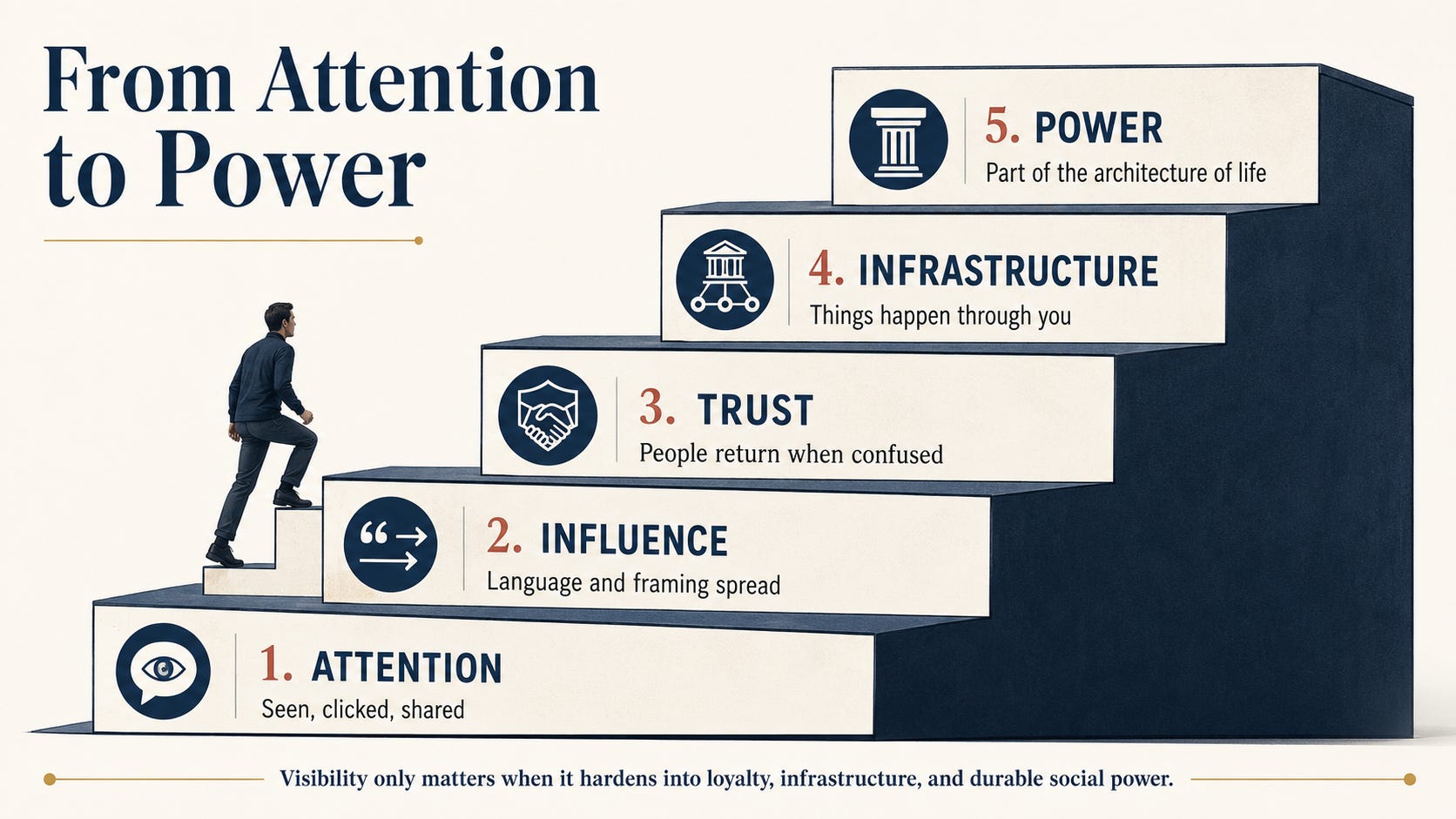
At the bottom is attention. People see you, click, laugh, share, react. This matters, but it is thin. People give attention to things they forget within hours.
Above attention is influence. People repeat your language, borrow your framing, use your categories. You have changed how they describe reality. Stronger, but still unstable: a man can repeat your words without changing his life.
Above influence is trust. People return to you when events become confusing. They give you the benefit of the doubt and recommend you to others. Trust depends on consistency, which is why outrage alone cannot produce it.
Above trust is infrastructure. People do things through you. They read through your publishing house, meet through your association, donate through your network. They form friendships, marriages, habits and obligations around the spaces you have built.
At the top is power. Power begins when people cannot replace you without losing something real. Not because you have trapped them, but because you have become part of the architecture of their lives.
A man with a million followers can vanish tomorrow and leave nothing behind but screenshots. A small institution with a few hundred loyal members can outlive its founder, train successors and shape a world after the noise has moved on. The question is not how many people saw it. The question is what exists now that did not exist before they saw it.
The production problem
The online Right produces reactions faster than it produces people. It generates commentary, memes and exposés at industrial speed. What it struggles to produce is formed men and women.
This is not a moral complaint about the internet, which broke media monopolies and gave isolated people access to books and friendships that official culture would never have offered. But the internet rewards instincts opposite to those required to build: speed over depth, reaction over formation, persona over character, novelty over repetition.
A man addicted to online political conflict may know every argument and still lack the discipline to lead ten people in real life. He may be correct about almost everything. If his political life consists only of consumption and reaction, his correctness becomes a private aesthetic. He watches the collapse as a genre.
This is why so many dissident spaces feel intense but weightless. They are full of people who can diagnose the system but cannot replace any part of it. They describe the failure of schools and build no school. They mock legacy media and fund no durable media. They attack atomisation and organise no brotherhood. Speech has become the substitute for construction.
The system knows how to handle outrage
Modern power has learned to metabolise dissent. It does not need to silence every critic. It often benefits from keeping critics visible, angry and contained inside platforms it controls. Anger drives engagement, engagement sells advertising, and the deeper structure remains untouched. The same institutions continue to educate the young, certify expertise, control payment rails and punish disobedience. The spectacle changes faster than the structure.
Symbolic victories seduce because they offer emotional closure without demanding anything. A minister contradicts himself. A famous liberal admits that something went too far. These moments matter only as openings. Too often we treat them as proof of victory. But an exhausted regime can rule for a long time, and a discredited elite still controls schools, banks, ministries, courts and professional access. A cultural class can lose confidence long before it loses command.
Exposure is not transfer. A loss of faith in the old system does not automatically create loyalty to something better. It often creates cynicism, private escape or spectatorship. A man can know that the system lies and still send his children into its schools, keep his money in its channels and spend his evenings consuming its entertainment. He has attention. Perhaps even influence. He has not exited.
What the system fears is replacement: parents who stop outsourcing moral formation, young men who find discipline and brotherhood outside approved channels, publishers who create their own prestige economy, donors who fund institutions rather than personalities, local networks that can mobilise without permission. Outrage becomes dangerous only when it turns into organised life. Until then, it is content.
What real power looks like
Real power looks unimpressive from the outside. A room that meets every month for years. A publication that pays its writers and trains new ones. Older men taking responsibility for younger men before crisis turns them into raw material for someone else. A small school with a clear moral order. A fund, a piece of land, a working archive, a table where people return.
None of this gives the rush of a viral humiliation. It creates continuity instead.
The test is simple: if your account disappeared tomorrow, what would remain? Would people still know each other? Would money still move? Would meetings still happen, children still be taught, books still be printed? If the answer is no, you have attention. You do not yet have power.
The test does not condemn public work. It gives public work its proper place: media, essays, podcasts and online conflict should feed recruitment and institution-building, bringing people from the surface into the structure. If they do not, they become a loop.
Platforms and pathways
Every serious movement must learn to convert attention into deeper commitment. A reader becomes a subscriber, a subscriber a participant, a participant a volunteer, a volunteer a leader, a leader a founder who trains successors. That chain does not build itself. Where does a sympathetic reader go after the essay? What can he join, learn, fund? What responsibility can he take within a year?
Most online projects never ask these questions, because they think in audiences. They build platforms, not pathways. A platform asks how to keep people watching. A pathway asks how to make people more useful. A media personality needs constant attention, while a movement builder wants people to outgrow passive consumption until they no longer need instructions from the centre. The goal is not a permanent audience. The goal is a people with memory, structure and will.
Why this matters now
Legitimacy and power are separating across the West. Many people no longer believe the official story. They see the managerial class protecting itself, the gap between public morality and private interest, elections that change the costume more than the machinery. That loss of belief creates an opening. It also creates danger.
When trust collapses and no serious alternative exists, people do not become free. They become manageable in new ways: entertainment, conspiracy, despair, dependence on whatever authority still provides order. A vacuum does not stay empty. If serious people do not build institutions, unserious people will build cults, scams and temporary mobs, and men who despise the official structures will return to them anyway, because official structures still organise life.
The coming years will produce more cracks, more scandals, more people searching for language that explains what they already sense. They must find more than commentary. They must find somewhere to go.
The viral moment belongs to whoever controls the platform today. The institution belongs to those who keep faith with each other after the founder is gone.
■
If you enjoyed this piece, please share it with others. To support my work, you can become a paid subscriber or make a one-time or recurring donation at donorbox.org/support-beyond-collapse. Thank you for helping keep Beyond Collapse independent.
Dan Erickson's succinct article on "Why the Right Keeps Mistaking Attention for Power" presents a vital discussion for the so-called dissident "Right." We spend too much time mistaking digital attention for progression forward with our goals and objectives. Reading and writing are so necessary, but they're not enough - and by themselves, they're exactly nothing. Additionally, negative attention - the doom porn - is often so much worse, honestly. Rob Rundo correctly identifies this, I think - and so do Sewell and Rousseau. We want glory and we want attention on where we win.
Prioritizing social cohesion and White unity remains paramount, and those willing to transition from reacting to doing will pave the way. The Australian European Movement is a great example - Sewell called them the vanguard, and they were/are (even disbanded they still are) - as are men like Rob Rundo, Thomas Rousseau, and others, as well as the women and families supporting them - showing that a forged brotherhood that precipitates forged families and communities - survives when algorithm resets.
Orania, Return to the Land, Ozarkia, and so many other initiatives securing physical sovereignty and local networks are imperative. Infrastructure - a parallel economy - guarantee more freedom of association that the ugly aliens of the NWO are less able to touch. Our goal must be the microcosm of society that endures to educate the next generation - with the seeds intact for real power building. This is best supported by initiatives to foster truth and beauty, which can also be mirrored in real time with local community events like book reading, artistic initiatives, and anything else encouraging our spiritual return to our people and gods.
Superb article. Could have been sub-titled "Why the modern right always loses"
One comment I had, was the missing element of the right elite class. At the end, whether its left or right, a movement has at its core, an "elite" - this is where I think the right fails probably through extreme complacency.